Trading Insights

AI Stock Research:
How to Use It Well.

Learn how to research a stock with AI step by step, what questions to ask, which company evidence matters, what to verify and where AI-generated research can mislead you.

AI Company Research August 2026 10 min read
AI Stock Research for NASDAQ Stocks

What is AI stock research?

AI stock research uses artificial intelligence to help collect, organise and explain information about publicly listed companies. This may include company information, financial performance, recent developments, market activity and technical chart structure.

The purpose is not to predict exactly where a stock will trade next. A useful AI research system should help reduce the time required to investigate a company while making the available information easier to understand and verify.

What can AI research about a stock?

A strong research process usually considers more than one type of information. AI can help bring several layers of company and market research together so they can be reviewed in a more organised way.

This can include what the business does, financial trends, recent company developments, market attention and the technical structure visible on the chart.

The key idea

Use AI to organise the research.
Keep the decision with you.

AI can reduce repetitive research work and explain complex information more clearly. It should support independent investigation rather than become a prediction engine or substitute for investor judgement.

A broader research picture

What AI stock research can bring together.

Company research becomes more useful when several relevant evidence layers can be considered together.

01
Company operations Understand the business, what it does and the market it operates in.
02
Financial performance Review earnings, revenue and other financial information relevant to the company.
03
Recent developments Investigate company news, announcements and other developments that may require attention.
04
Market activity Add context from unusual market behaviour without treating it as confirmed buying or selling.
05
Technical structure Continue into support, resistance, trend, consolidation, breakout structure and volume.
Research is not prediction

Information and context
versus certainty and calls.

AI research can help

AI is most useful when it stays focused on organising evidence and explaining relevant context.

✓
Summarise company operations and financial information.
✓
Highlight recent developments that deserve further investigation.
✓
Explain technical chart structure in clearer language.
✓
Reduce the friction between stock discovery and company research.

AI research cannot guarantee

Information and analysis can improve understanding, but they cannot remove market uncertainty.

—
That a stock will rise or fall next.
—
An exact future stock price.
—
That unusual market activity represents confirmed institutional buying.
—
That an AI-generated summary is a buy, sell or hold recommendation.
Practical workflow

How to research a stock with AI.

A useful AI research process moves from understanding the business to checking the numbers, identifying recent changes, reviewing risks and then verifying the most important claims.

01

Understand the business

Start with what the company sells, who its customers are, how it makes money and which markets or products matter most.

02

Check financial direction

Review revenue, earnings, margins, cash, debt and whether financial performance is improving, weakening or remaining mixed.

03

Find what changed

Investigate recent earnings, guidance, company announcements, major news, product developments and other new information.

04

Look for risks

Ask about dilution, debt, cash needs, regulatory issues, concentration risk, weak profitability and other factors that could change the research picture.

05

Verify the evidence

Check important claims against company disclosures, SEC filings, earnings releases and other reliable primary information before relying on the summary.

Worked example

You find a NASDAQ stock near resistance. What should you research next?

Instead of asking AI whether the stock is a “good buy”, use it to build a research checklist. Useful questions could include:

  • What does this company do, and which products or business segments generate most of its revenue?
  • How did revenue and earnings change in the most recent reported period compared with the previous year?
  • Did management change guidance, expectations or important business targets?
  • What recent company news or filings could materially change the investment story?
  • What does the balance sheet show about cash, debt and future funding needs?
  • Are there dilution risks such as new share issuance, shelf registrations, convertibles or other financing arrangements?
  • What are the strongest arguments against the positive case?
  • Which claims in this summary should be checked directly in the company's filings or earnings release?

This approach makes AI more useful because it turns a stock idea into a structured investigation. The goal is not to make AI decide whether to buy the stock; it is to make sure important evidence is not overlooked.

Why use AI for stock research?

Researching an individual stock can involve company websites, financial information, filings, news, market data and technical charts. Moving between these sources repeatedly can make the process slow and fragmented.

AI can help organise relevant information and explain it in a more structured format. This can be particularly useful once a stock has already been surfaced as worthy of further investigation.

AI research and NASDAQ stock discovery

One of the challenges with the NASDAQ is scale. More than 3,200 NASDAQ-listed stocks can make manual review unrealistic.

A more efficient process is to first use automated scanning to narrow the market to a smaller research set. AI can then help investigate the companies that survive that initial discovery process.

This creates a clearer sequence: scan the market, identify relevant technical structures, narrow the number of stocks requiring attention, then investigate company and chart information in more depth.

Market activity needs careful interpretation

Market activity data can add another layer to company research, particularly when behaviour appears unusual relative to a stock's recent history.

However, off-exchange or multi-venue activity does not identify buy or sell direction and does not prove institutional accumulation. It is more appropriately treated as context for further investigation rather than confirmation of who is behind the activity.

Independent verification still matters

AI can be incomplete, outdated or wrong. Important financial information, company announcements, filings and other material details should still be checked against appropriate primary or trusted sources.

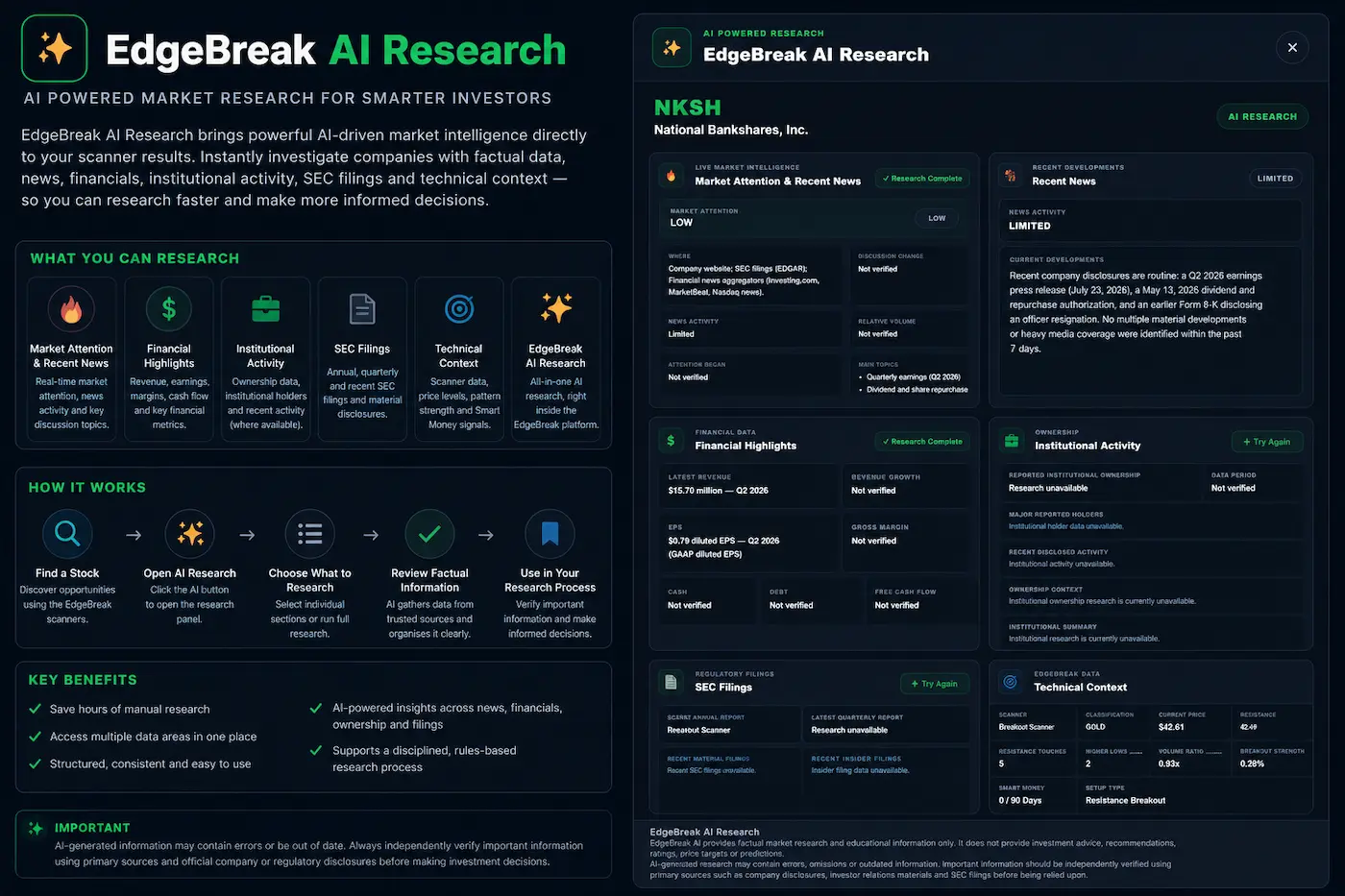
The value of AI is in making the research process easier to navigate, not in removing the need to verify what matters. If you want to use this workflow inside EdgeBreak, the AI Stock Research tool brings company information, financial highlights, news, filings and market context into one research process.
Verify the important parts

Where should AI-generated stock research be checked?

AI can help locate and explain information, but material facts should be checked against the most authoritative source available.

SEC filings Use regulatory filings to verify reported financial information, material risks, securities offerings, ownership disclosures and other official company information.
Earnings releases Check the company's reported revenue, earnings, guidance, management commentary and period-to-period changes against the original release.
Investor relations Company investor-relations pages can provide presentations, announcements, financial reports and other primary company material.
Original market data Re-check price, volume and technical observations against the underlying chart or market-data source rather than relying only on a generated description.
How EdgeBreak approaches this

Discover the stock.
Then investigate the evidence.

EdgeBreak combines automated NASDAQ stock discovery with AI-assisted company and chart research so users can move from a surfaced technical setup into a broader independent research process.

✓
Narrow the NASDAQ EdgeBreak scans more than 3,200 NASDAQ-listed stocks and uses rules-based filters to reduce the amount of market information requiring attention.
✓
Research the company AI-assisted research can organise company information, financial highlights, recent news, filings and market activity context.
✓
Analyse the chart AI Chart Analysis can explain support, resistance, trends, consolidation and volume without issuing buy, sell or hold recommendations.

Final thoughts

AI stock research can make company and market investigation faster and easier to navigate, particularly when it is combined with structured stock discovery.

Its strongest role is not predicting the market. It is helping investors organise company information, financial context, recent developments, market activity and technical charts so the evidence can be reviewed more efficiently.

Used carefully, AI becomes another layer inside a transparent research process while verification and investment decisions remain with the investor.

AI stock research FAQ

Common questions.

What is AI stock research?

AI stock research uses artificial intelligence to help collect, organise and explain company, financial, market and technical information. It can make research faster, but important information still needs independent verification.

What should I ask AI when researching a stock?

Useful questions focus on the business model, revenue and earnings direction, recent company developments, guidance, balance-sheet strength, dilution risk, regulatory filings and the strongest risks to the investment case.

Can AI analyse SEC filings?

AI can help summarise and explain information from filings, but material details should be checked against the original filing because generated summaries can omit, misunderstand or misstate important information.

Can AI tell me whether a stock is a good investment?

AI can organise evidence and explain information, but it cannot remove uncertainty or guarantee future performance. A research tool should support independent judgement, not replace it.

What are the main risks of AI stock research?

AI can produce outdated, incomplete or incorrect information, confuse companies, misread financial context or overstate conclusions. Important facts should always be verified using reliable primary sources.

Discover first

Then research
what matters.

Use EdgeBreak to discover NASDAQ stocks and continue your research with company information, chart analysis and market activity context.

Chart Analyzer $25 • Standard $35 • Full Access $50
Research and educational information only • Not financial advice