Why EdgeBreak Is NASDAQ Only

Why We Built a NASDAQ-Only Scanner
and Why All-in-One Screeners Fail Breakout Traders.

Different markets behave differently. We built EdgeBreak around one defined market universe because breakout scanner logic should be designed for the stocks it is actually scanning — not diluted into broad rules intended to work everywhere.

Trading Insights September 2026 9 min read
The short version

We chose depth over coverage.

Many screeners are built to cover everything: multiple exchanges, ETFs, small caps, international stocks and sometimes entirely different asset classes. That makes them flexible, but it can also force the scanner to rely on broad, general rules. EdgeBreak takes the opposite approach: focus on NASDAQ-listed stocks and build the scanner logic around that universe.

A common question

Isn't choosing “NASDAQ” in an all-market screener the same thing?

No — filtering the universe and designing for the universe are different jobs.

An all-market screener can let you choose NASDAQ as an exchange filter, and that can be useful. But the underlying definitions of momentum, breakout, volume, resistance or trend may still be the same general-purpose definitions used across every market the platform supports.

EdgeBreak starts from the opposite direction. NASDAQ is the universe first. The scanner rules are then designed around the type of NASDAQ technical structures we want to research: long bases, repeated resistance, higher lows, tightening price action, confirmed resistance breaks, liquidity and whether a move has already become extended.

That does not make a NASDAQ-only scanner automatically superior. It makes it more specialised — and specialisation is the point.

Why not scan every market?

At first glance, a scanner that covers more markets sounds better. More stocks, more exchanges and more filters can look like more opportunity.

The problem is that markets are not identical. Different exchanges contain different mixes of companies, liquidity profiles, price behaviour and technical characteristics. A rule that produces useful breakout candidates in one universe may create noise in another.

For breakout research, that matters. The scanner is not simply looking for a stock that went up today. It is trying to interpret structure: resistance, support, higher lows, consolidation, liquidity, breakout confirmation and how far price has already moved from the base.

General-purpose screeners solve a different problem

An all-in-one screener is often designed to be flexible. It may let a user filter by exchange, market capitalisation, price, volume, valuation, sector or dozens of other variables. That can be useful when the user already knows exactly which filters to build.

But breakout traders often need something more specific than a giant filter menu. They need the scanner itself to understand the setup being researched.

If the underlying system treats every market in the same way, the burden shifts back to the user: manually adjust filters, inspect large result lists and decide whether the technical structure is actually relevant. That is the problem EdgeBreak was designed to reduce.
Why market-specific scanning matters

Breakout logic works better when the universe is defined.

Narrowing the market lets the scanner rules be designed around a more consistent research universe.

01

One defined universe

EdgeBreak is built around NASDAQ-listed stocks rather than mixing many exchanges with very different market characteristics.

02

More specific structure rules

Resistance, higher lows, consolidation and breakout confirmation can be treated as part of one dedicated breakout research process.

03

Better control of noise

Liquidity, volume and distance-from-base filters can be applied consistently to the market EdgeBreak is actually designed to research.

04

A consistent workflow

Discovery, pre-breakout research, confirmed breakouts, company research and chart analysis can all use the same NASDAQ-focused starting point.

Different design philosophies

All-in-one screener versus dedicated NASDAQ breakout scanner.

All-in-one screener

Built to serve many strategies, markets and user types at once.

Very broad exchange and asset coverage.
Large libraries of general filters.
Useful for users who want to build their own custom screens.
Often requires more manual filtering for a specialised breakout process.

NASDAQ-only breakout scanner

Built around one market and a narrower research objective.

Scanner rules designed around NASDAQ-listed stocks.
Breakout and pre-breakout structure built into the workflow.
Liquidity and extension filters designed to reduce irrelevant results.
Designed to move directly from discovery into deeper research.

Why breakout traders need more than generic filters

Breakout trading is heavily dependent on context. A stock being close to its 52-week high does not automatically mean it has a strong breakout structure. A volume spike does not automatically mean accumulation. A stock moving above yesterday's high does not necessarily mean meaningful resistance has been broken.

A specialised breakout scanner needs to consider how the setup developed before the move. That may include repeated resistance, higher lows, organised consolidation, support behaviour, liquidity and whether price is still close enough to the base to remain useful for research.

This is why a simple “price above resistance” filter can produce weak results. The quality of the structure underneath that breakout matters.

Why NASDAQ became the EdgeBreak focus

EdgeBreak was built around the idea that specialisation is more useful than trying to become another universal market screener.

By keeping the stock universe focused on NASDAQ-listed companies, the platform can use the same defined universe across its Launch Pad, Pre-Breakout and Breakout research stages. That creates a more consistent path from long developing bases, to stocks approaching resistance, to stocks that have actually moved through resistance.

It also means the research tools around the scanner can stay aligned. AI Stock Research, chart analysis and workspace tools all begin from the same NASDAQ-focused discovery process.

Does this mean NASDAQ is “better” than every other market?

No. That is not the claim.

Other exchanges and markets can produce excellent companies, technical setups and trading opportunities. The point is that trying to cover everything is not the same thing as specialising in something.

EdgeBreak chose NASDAQ so its scanner logic, research tools and educational material could be designed around one defined market instead of applying the same general approach everywhere.

Real EdgeBreak scanner examples

Three scanners. Three different stages of structure.

These examples show why EdgeBreak does not treat every technical setup as the same thing. Launch Pad, Pre-Breakout and Breakout are designed to surface different stages of NASDAQ market structure.

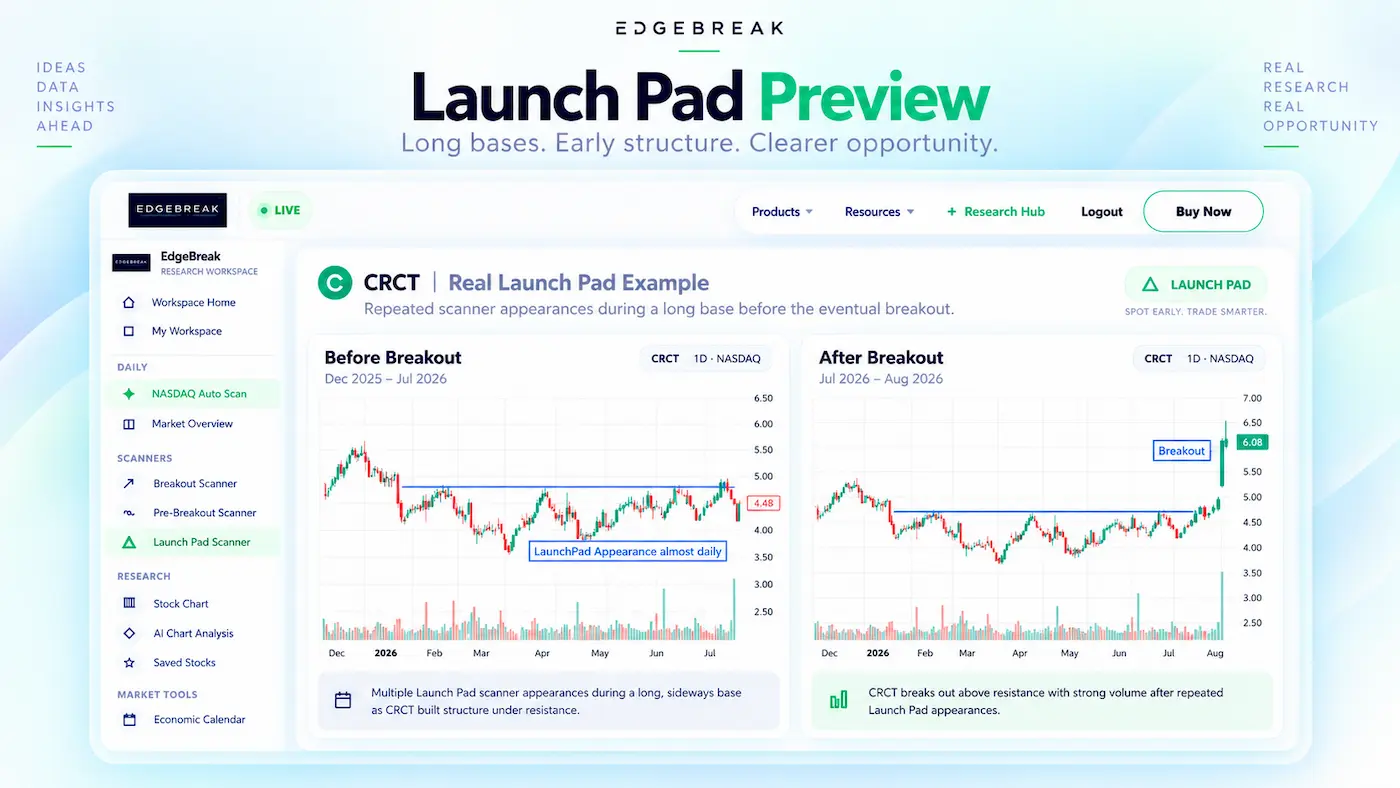
Real EdgeBreak Launch Pad example showing NASDAQ stock CRCT trading in a long base before a later breakout
Launch Pad • CRCT

A long base before the move.

CRCT appeared repeatedly in the EdgeBreak Launch Pad scanner while price remained inside a broad multi-month base beneath established resistance. The later chart shows price eventually moving above that resistance area. The scanner identified the existing base structure — it did not predict that a breakout had to occur.

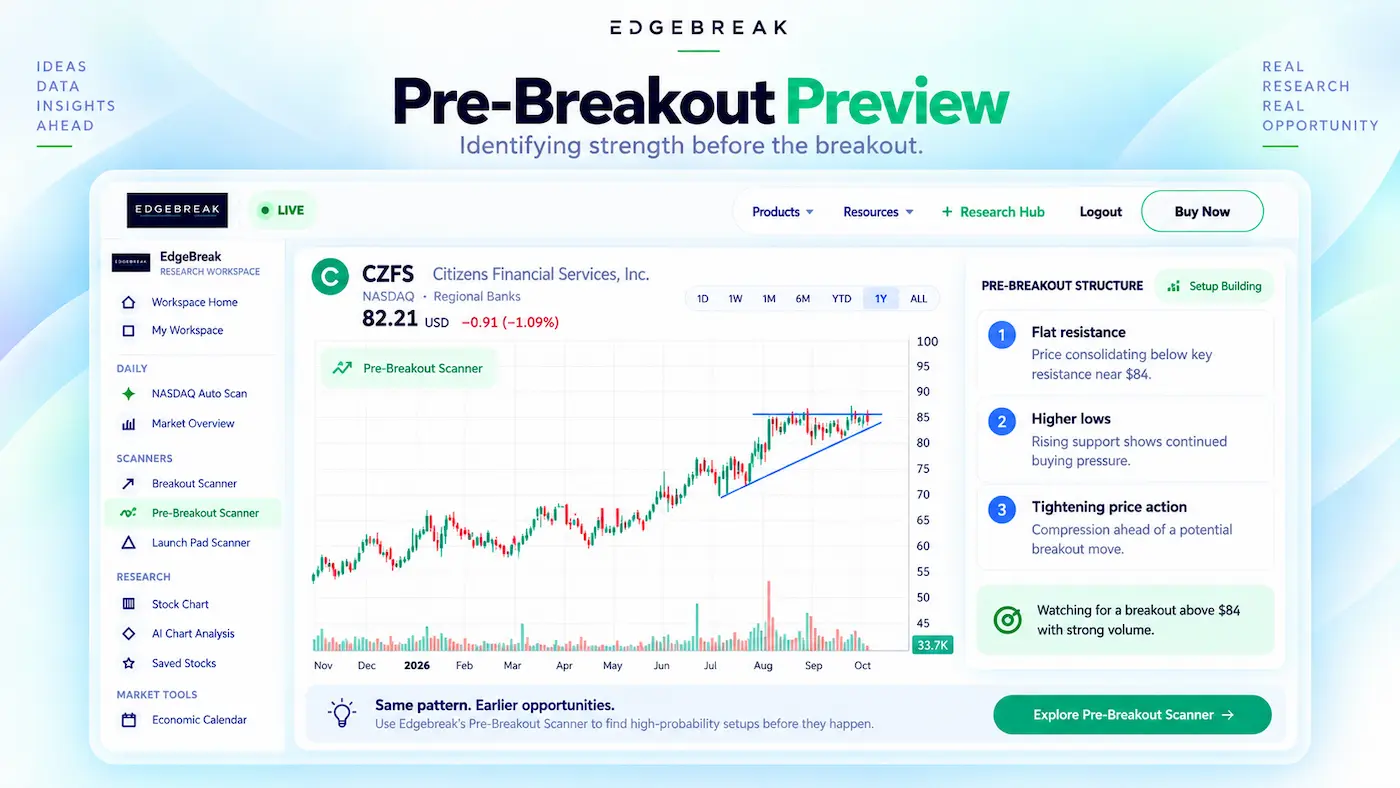
Real EdgeBreak Pre-Breakout Scanner example showing NASDAQ stock CZFS consolidating beneath resistance with higher lows
Pre-Breakout • CZFS

Structure building beneath resistance.

CZFS is an example of the type of chart the Pre-Breakout Scanner is designed to surface: relatively flat resistance near the top of the structure, rising support and tighter price action beneath it. This is a current setup example, not a claim that a future breakout will occur.

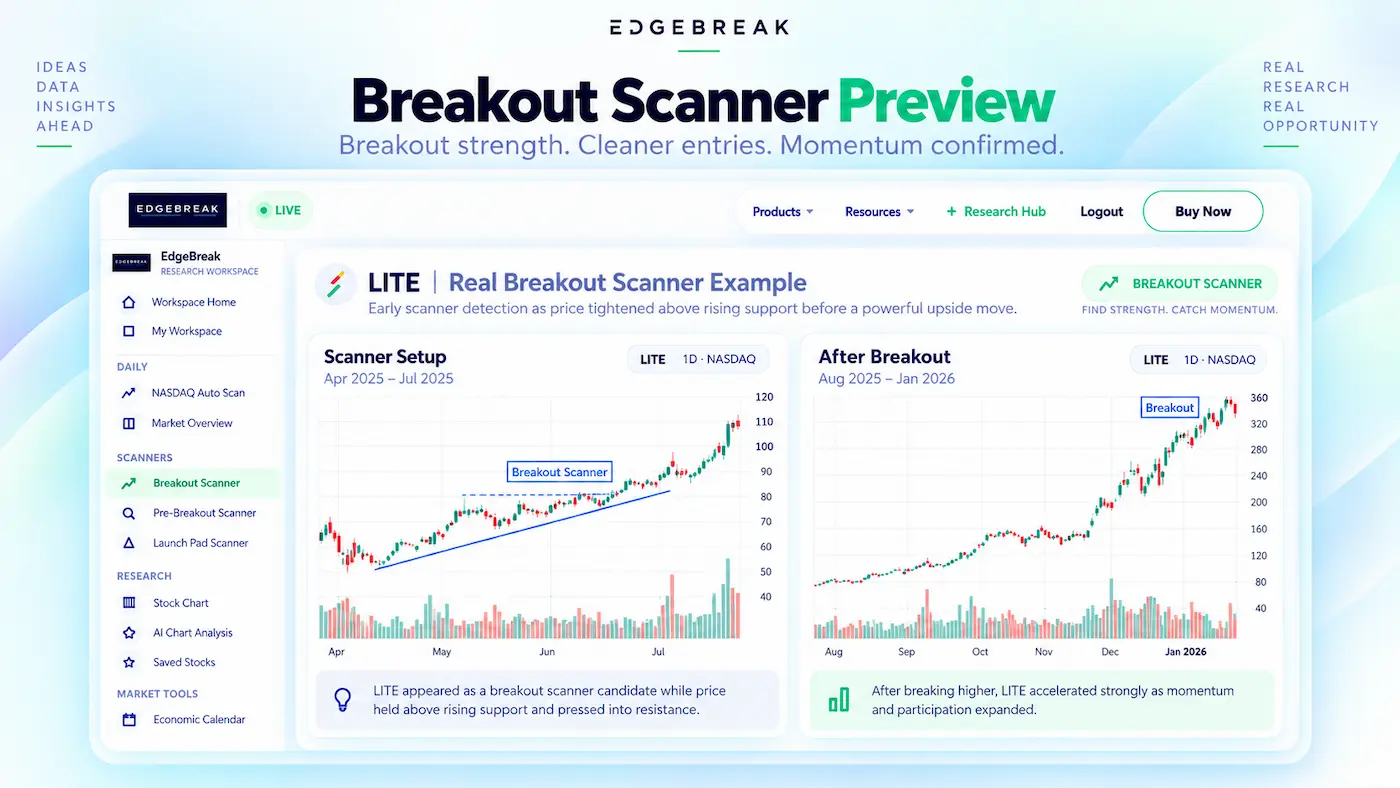
Historical EdgeBreak Breakout Scanner example showing NASDAQ stock LITE around a breakout setup before a later move higher
Breakout • LITE

A confirmed breakout, followed by a larger move.

LITE provides a historical Breakout Scanner example. EdgeBreak surfaced the stock around a qualifying breakout structure; the later chart shows that price subsequently continued substantially higher. This is a historical illustration of scanner behaviour, not evidence that future scanner results will behave the same way.

What these examples prove — and what they do not.

They show the types of NASDAQ structures EdgeBreak's scanners are built to identify. They do not prove that every Launch Pad or Pre-Breakout setup will break out, or that every confirmed breakout will continue higher. Failed setups and reversals are part of real markets, which is why EdgeBreak treats scanner results as research candidates rather than buy, sell or hold recommendations.

NASDAQ research from anywhere

Built around U.S. stocks, used from the U.S., Canada and Australia.

The scanner universe is NASDAQ-listed stocks. The investor researching that universe does not need to be located in the United States.

United States

U.S.-based users can research NASDAQ breakout and pre-breakout structures directly within their home market, whether they prefer daily research or more active workflows.

Canada

Canadian investors can use the same NASDAQ-focused research process while separately considering their brokerage, currency and local account requirements.

Australia

Australian users can research the same NASDAQ-listed stocks, with end-of-day and next-morning workflows often fitting naturally around U.S. market hours.

A practical way to compare scanners

Six questions a breakout trader should ask.

Ignore the size of the filter menu for a moment. Ask whether the scanner actually understands the setup you are trying to research.

1. What counts as resistance? Can you understand why the level matters, or is “resistance” simply a generic threshold?
2. Does structure matter? Does the scanner consider higher lows, consolidation or repeated interaction beneath resistance?
3. Is liquidity controlled? Can low-quality or thin results be filtered before they dominate the list?
4. Is pre-breakout different? Does the platform distinguish a developing setup from a confirmed move through resistance?
5. Does it control extension? Can it avoid surfacing stocks only after price has already travelled far beyond the original base?
6. What happens after discovery? Can you move directly into chart, company, filing and market research without rebuilding the process elsewhere?
The EdgeBreak approach

One market.
Several stages of research.

EdgeBreak does not try to scan every exchange with one generic ruleset. Its three NASDAQ scanners look at different stages of technical structure: longer bases, developing pre-breakout formations and confirmed resistance breaks. A stock does not need to pass through every scanner in sequence.

Launch Pad Research longer developing bases and established trading ranges.
Pre-Breakout Find stocks approaching resistance with developing technical structure.
Breakout Research stocks that have moved through established resistance without assuming the breakout will succeed.
NASDAQ scanner FAQ

Common questions.

Why use a NASDAQ-only stock scanner?

A NASDAQ-only scanner can be designed around one defined stock universe rather than applying broad rules across multiple exchanges. That allows breakout, pre-breakout, liquidity and structure rules to stay more focused.

Why can all-market screeners be less useful for breakout traders?

Broad screeners often need flexible, general filters that work across many types of securities. Breakout research can require more specialised treatment of resistance, higher lows, consolidation, liquidity, volume and distance from the base.

Is NASDAQ better than every other market for breakout trading?

No. EdgeBreak's NASDAQ-only approach is about specialisation, not claiming other markets are inferior. Focusing on one market allows the scanner and research workflow to be designed around a defined universe.

What does a breakout trader need from a stock scanner?

Useful features can include established resistance, higher lows, consolidation, liquidity filters, volume context, breakout confirmation and controls for stocks that are already extended.

Can investors in Canada and Australia use a NASDAQ scanner?

Yes. Investors outside the United States can research NASDAQ-listed stocks using web-based platforms, subject to regional availability and their own brokerage, tax and local requirements.

Focused by design

We don't scan everything.
We scan NASDAQ with purpose.

Explore a NASDAQ-focused research platform built around Launch Pad, Pre-Breakout and Breakout scanner logic rather than one generic all-market screen.

Research and educational information only • Not financial advice