Building Confidence Through Research
Confidence is often misunderstood in financial markets. Many people believe confidence comes from correctly predicting price movements, but experienced market researchers understand that true confidence develops through knowledge, preparation and a consistent research process. This lesson explains how to build confidence by improving your research rather than attempting to predict the future.
What You'll Learn
- Where genuine confidence comes from.
- Why research reduces uncertainty.
- The importance of repetition.
- Developing pattern recognition.
- Building confidence through continuous learning.
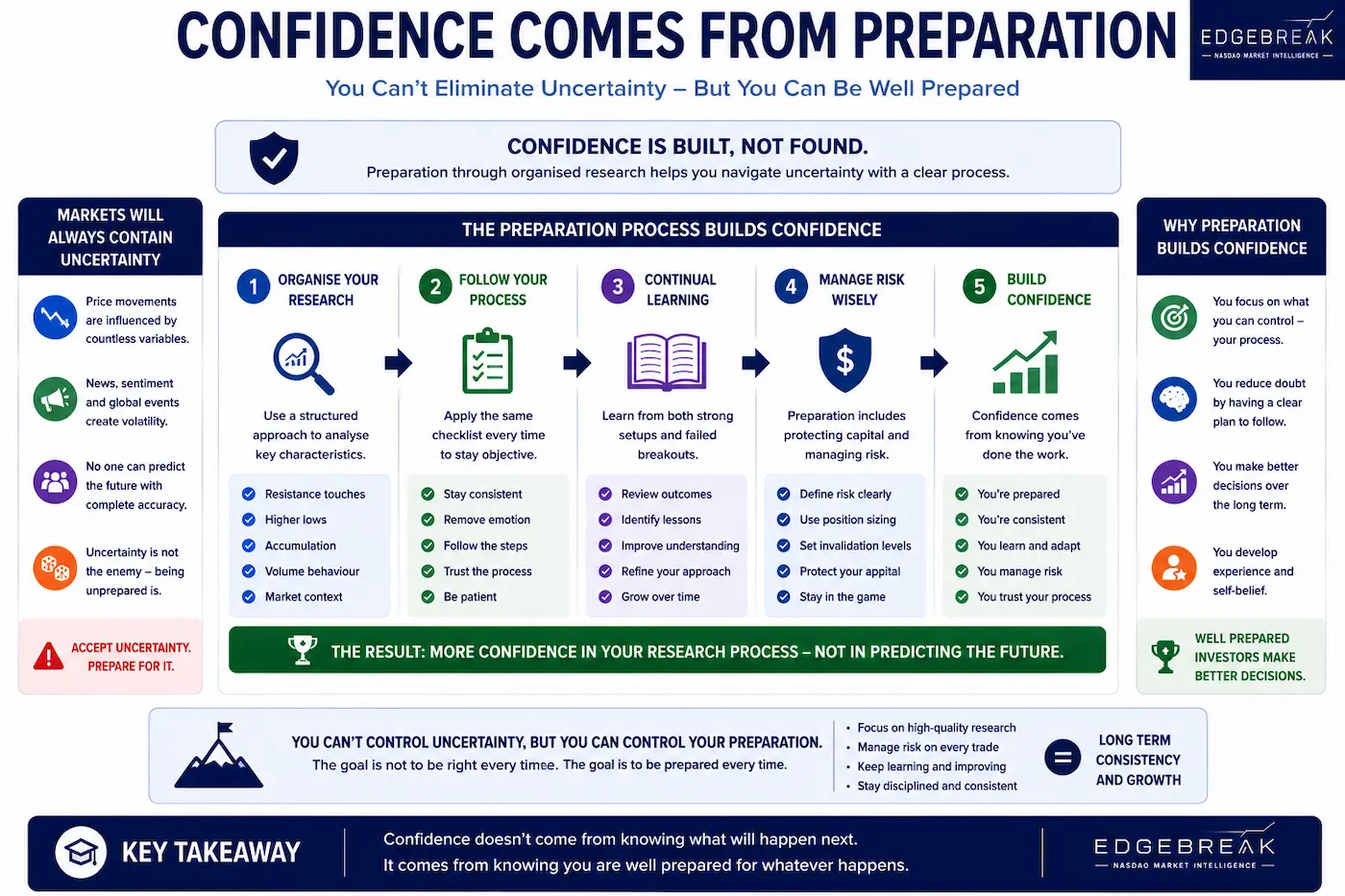
Confidence Comes from Preparation
Markets will always contain uncertainty.
No investor, analyst or research platform can predict future price movements with complete accuracy.
Instead of trying to eliminate uncertainty, focus on becoming well prepared through organised research and continual learning.
The better prepared you are, the more confident you become in your research process.
Experience Builds Pattern Recognition
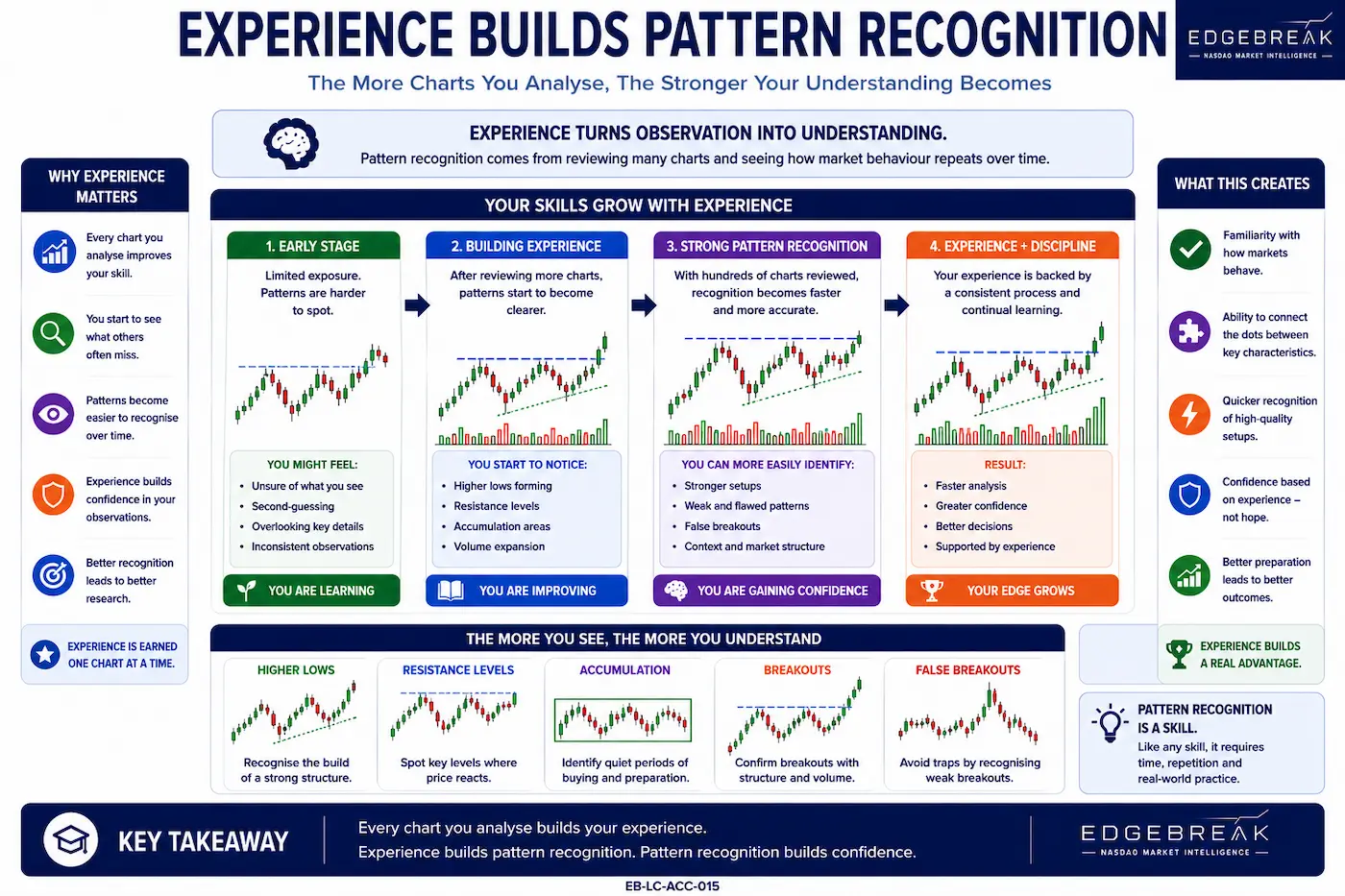
Every chart you analyse strengthens your understanding of market behaviour.
After reviewing hundreds of charts, patterns such as higher lows, resistance, accumulation and breakout structures become easier to recognise.
This growing familiarity creates confidence because your observations are supported by experience rather than assumptions.
Follow the Same Research Process
Confidence grows when your research process remains consistent.
Every time you use EdgeBreak, work through the same structured workflow:
- Search the NASDAQ Scanner.
- Apply your preferred filters.
- Use the Smart Money Filter.
- Review the TradingView chart.
- Compare market structure.
- Save quality research candidates to My Workspace.
Following the same process every session helps remove unnecessary emotion and creates confidence through repetition.
Learn From Every Chart
Every chart has something to teach.
Some examples demonstrate excellent accumulation and organised market structure, while others show why certain breakout structures fail.
Treat every chart as an opportunity to improve your understanding of market behaviour.
The goal is continual improvement—not perfection.
Compare Yourself Only With Yourself
Financial markets are full of opinions, predictions and success stories.
Rather than comparing yourself with others, compare today's research process with the one you followed six months ago.
Ask yourself:
- Do I recognise market structure more quickly?
- Am I more organised?
- Has my chart analysis improved?
- Do I follow a more consistent routine?
Progress is measured by improvement, not comparison.
Confidence Doesn't Mean Certainty
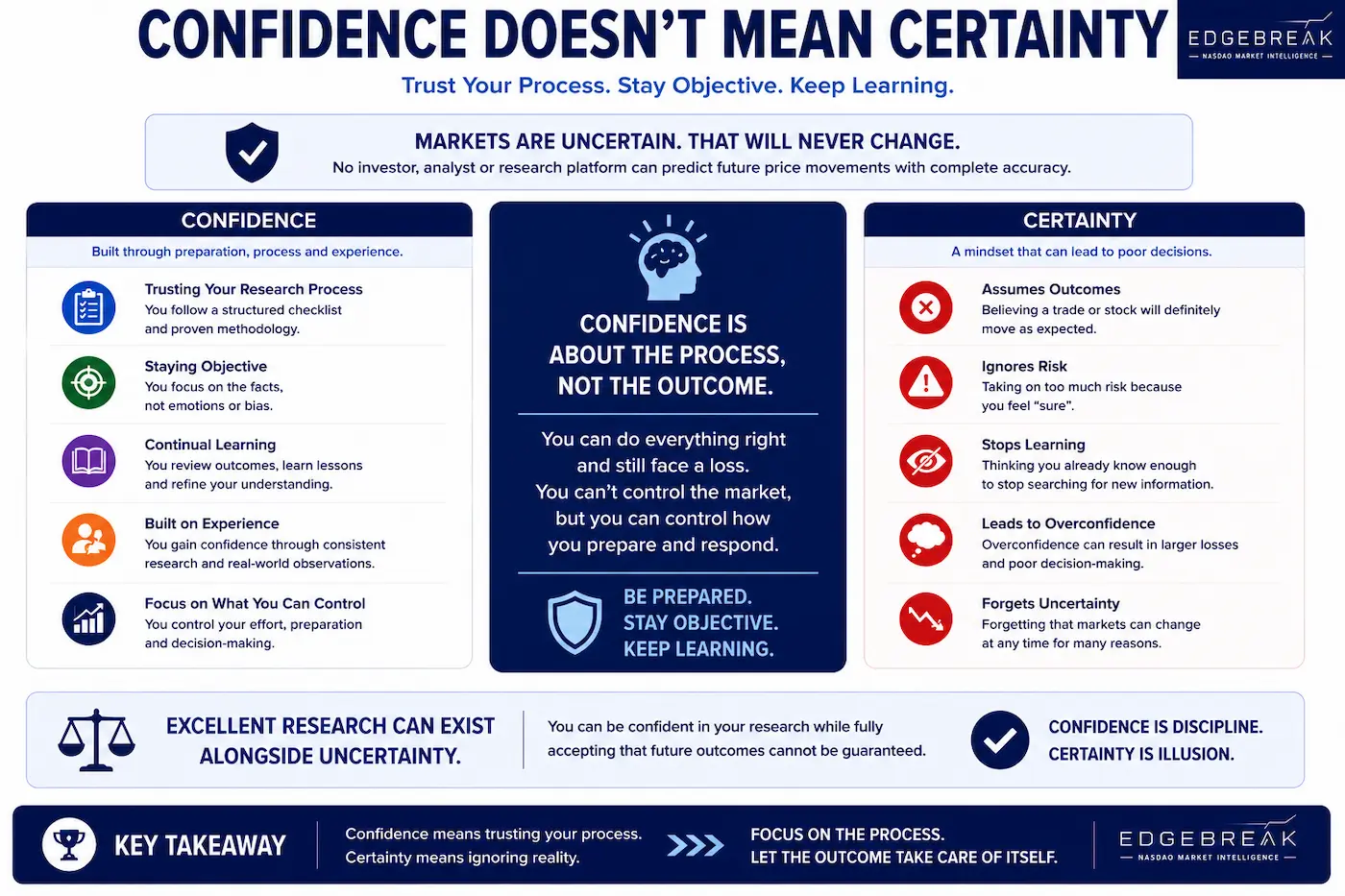
Confident researchers understand that markets remain uncertain.
Confidence simply means trusting your research process, remaining objective and continually learning from new information.
It is entirely possible to conduct excellent research while recognising that future market outcomes cannot be guaranteed.
Keep Building Your Knowledge
Confidence develops gradually through education and experience.
Continue reviewing Academy lessons, reading EdgeBreak articles, analysing historical charts and exploring new market structures.
Every hour spent learning contributes to becoming a more knowledgeable and disciplined market researcher.

EdgeBreak Academy. A structured learning platform containing step-by-step lessons covering market structure, resistance, higher lows, accumulation, volume behaviour and the complete EdgeBreak research workflow.
Confidence Is a Long-Term Process
There is no point at which an investor knows everything.
Even experienced market researchers continue learning, reviewing charts and refining their research process.
True confidence comes from knowing you have a structured framework for analysing markets—not from believing you can predict every outcome.
Lesson Summary
Confidence is built through preparation, consistency and continual learning. By following the same structured research process, studying hundreds of charts and regularly reviewing your own work, you gradually develop the experience and pattern recognition needed to become a more capable independent market researcher.
Key Takeaways
- Confidence comes from preparation, not prediction.
- Review as many charts as possible.
- Follow a consistent research process.
- Learn from every market example.
- Continue improving through education and experience.
Practical Exercise
Review ten different NASDAQ stocks using the complete EdgeBreak workflow.
- Analyse the market structure.
- Identify resistance levels.
- Review higher lows.
- Assess the volume behaviour.
- Write down one new observation from each chart.
The objective is not to identify the "best" stock, but to strengthen your pattern recognition through repetition.
Research Reminder
Confidence in market research comes from knowledge, experience and a disciplined process—not certainty about future price movements. EdgeBreak Academy provides educational resources to support independent research and does not provide financial advice or investment recommendations.
Continue Your Journey
Lesson 6.4 – Developing Your Own Research Style
Learn how to refine your own research preferences while remaining consistent with the structured EdgeBreak methodology. Develop a repeatable approach that suits your goals while continuing to build confidence as an independent market researcher.