Trading Insights

Build a better
Stock Watchlist.

Learn how to build a focused list of NASDAQ stocks worth monitoring using market structure, resistance, higher lows, consolidation and a consistent review process.

Watchlist Research June 2026 8 min read
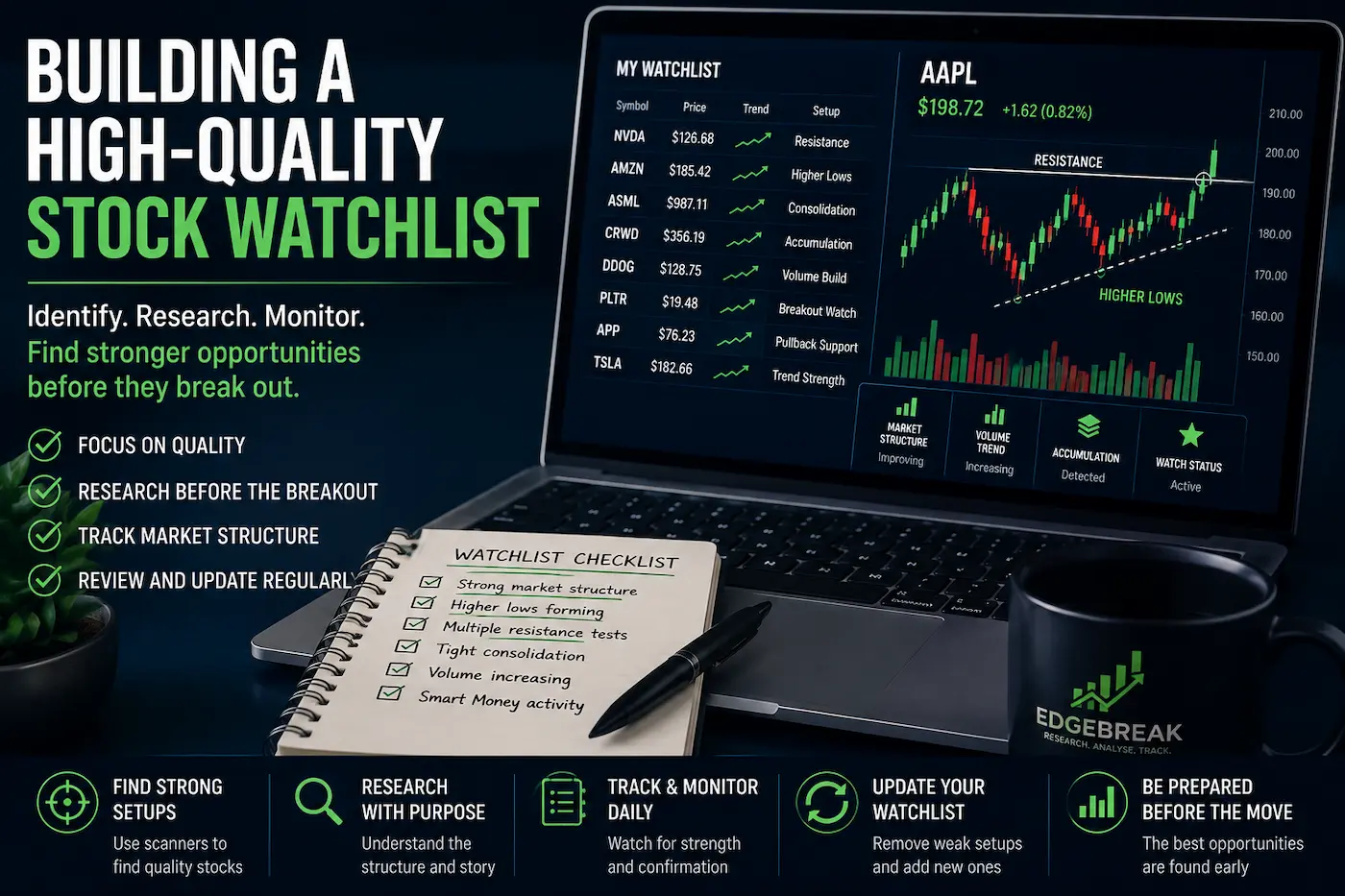
Building a High-Quality Stock Watchlist

Why every investor needs a watchlist

Markets produce more potential research ideas than any investor can follow closely. A watchlist creates a smaller, deliberate group of stocks that already meet your research criteria and deserve continued attention.

Instead of reacting to whatever is moving today, a structured watchlist lets you observe how technical setups develop over time. This can make the research process more organised, repeatable and less dependent on short-term market noise.

Quality matters more than quantity

A larger watchlist does not automatically create a better research process. If the list becomes too crowded, important changes in individual stocks can easily be missed.

A smaller group of higher-quality candidates gives you more time to understand each stock's market structure, monitor important price levels and follow how the setup changes from one session to the next.

The key idea

A watchlist is not a buy list.
It is a research list.

Stocks belong on a watchlist because something about the structure deserves continued investigation. They should remain there only while the original research case continues to make sense.

What deserves attention

Five things worth monitoring.

A useful watchlist focuses on observable changes in the structure rather than collecting every stock that appears interesting for a day.

01
Clear resistance A recognisable price area gives the setup an important level to monitor over time.
02
Higher lows Rising support can show that the technical structure is becoming more constructive.
03
Tight consolidation More organised price action can make the stock easier to monitor against defined levels.
04
Volume context Changes in trading activity can add context when interpreted alongside the price structure.
05
Ongoing relevance The stock should remain on the list only while the original research reason still applies.
Keep the list useful

What earns a place
versus what earns removal.

Keep monitoring

A stock can remain useful when the structure continues to support the original research reason.

✓
Resistance and support remain technically meaningful.
✓
Higher lows or organised consolidation continue to develop.
✓
The stock remains close enough to the original structure to be relevant.
✓
New company or market information strengthens the case for further research.

Remove or reassess

A disciplined watchlist should also make it easy to recognise when a research idea has deteriorated.

—
Support repeatedly fails or the structure becomes disorganised.
—
Lower highs and weaker closes begin to dominate.
—
The stock becomes too extended from the base that originally made it interesting.
—
The original research reason no longer exists.

Look for developing breakout characteristics

For investors researching breakout structures, repeated resistance tests, higher lows and tighter consolidation can be useful watchlist characteristics. These behaviours do not predict that a breakout will occur, but they can make a stock worth monitoring as the structure develops.

Volume and broader market behaviour can add further context, but no single characteristic should determine whether a stock deserves continued attention.

Review the list regularly

A watchlist should change as the market changes. Stocks that looked constructive several weeks ago may weaken, become too extended or lose the technical characteristics that originally made them interesting.

Regular review keeps the list relevant. It also prevents a watchlist from becoming an archive of old ideas that no longer match the current market.

Do not chase every breakout

One advantage of maintaining a watchlist is that you can research a stock before a major move occurs. By the time a stock becomes one of the day's biggest movers, the original structure may already be far behind it.

Monitoring the setup in advance gives you more context around the resistance level, the quality of the base and how the stock behaved before the move.

Organise the research process

A useful routine does not need to be complicated. Start with stock discovery, save the candidates that genuinely deserve attention, and then review them against the same technical and company-research criteria over time.

Consistency matters because it makes it easier to recognise whether a stock is improving, weakening or simply doing nothing.

How EdgeBreak approaches this

Find the stock.
Save the research.

EdgeBreak combines NASDAQ stock discovery with personal watchlists and My Workspace so users can move from a surfaced setup into continued independent research without losing track of the original idea.

✓
Discover candidates Automated scanning and technical scanners help reduce more than 3,200 NASDAQ-listed stocks into a smaller research set.
✓
Save what matters Personal watchlists and My Workspace help users keep selected stocks organised for ongoing investigation.
✓
Continue the research EdgeBreak Charts charts, AI company research, chart analysis and market activity context can be used to keep checking the evidence over time.

Final thoughts

Building a high-quality stock watchlist is less about collecting more tickers and more about deciding what genuinely deserves continued attention.

Clear technical structure, defined resistance, higher lows, organised consolidation and regular review can all help make a watchlist more useful without turning it into a list of predictions.

The goal is a smaller, cleaner research process that helps you follow how selected stocks develop while remaining willing to remove them when the evidence changes.

Keep the shortlist focused

Find it.
Save it. Research it.

Use EdgeBreak to discover NASDAQ stocks, build personal watchlists and continue your research with charts, company information and market activity context.

Chart Analyzer $25 • Standard $35 • Full Access $50
Research and educational information only • Not financial advice